---
title: "AI for Landing Zone: Titanium Agent"
description: Explore how AWS's Titanium Agent leverages AI to streamline the creation of secure, multi-account landing zones, reducing effort and ensuring best practices.
image: https://blog.ippon.tech/hubfs/titanum.jpeg
---
[Skip to main content](https://blog.ippon.tech/ai-for-landing-zone-titanium-agent#main)
[   ](https://ipponusa.com/)
- [Home](https://ipponusa.com)
- [Show submenu for About About](https://ipponusa.com/about-us)
- [Who We Are](https://ipponusa.com/who-we-are)
- [Careers](https://ipponusa.com/careers)
- [Show submenu for Our Partners Our Partners](https://ipponusa.com/our-partners/)
- [AWS](https://ipponusa.com/our-partners/aws/)
- [Snowflake](https://ipponusa.com/our-partners/snowflake/)
- [Databricks](https://ipponusa.com/our-partners/databricks/)
- [Microsoft](https://ipponusa.com/our-partners/microsoft/)
- [Show submenu for Services Services](https://ipponusa.com/services)
- [Snowflake](https://ipponusa.com/service/snowflake-concierge/)
- [Artificial Intelligence](https://ipponusa.com/service/artificial-intelligence/)
- [Data & Analytics](https://ipponusa.com/service/data-analytics/)
- [Cloud Strategy](https://ipponusa.com/service/cloud-strategy/)
- [Platform Modernization](https://ipponusa.com/service/platform-moderization/)
- [Product Innovation](https://ipponusa.com/service/product-innovation/)
- [Operating Model](https://ipponusa.com/service/operating-model/)
- [Blogs](https://blog.ippon.tech/)
- [Success Stories](https://ipponusa.com/success-stories/)
- [Show submenu for Resources Resources](https://ipponusa.com/resources/)
- [eBooks](https://ipponusa.com/ebooks/)
- [The Data Pour](https://info.ippon.tech/the-data-pour)
- [Videos & Webinars](https://info.ippon.tech/videos-and-webinars)
- [Media Center](https://ipponusa.com/media-center/)
Search
Open main navigation
Close main navigation
- [Home](https://ipponusa.com)
- Show submenu for About About
- About
- [About](https://ipponusa.com/about-us)
- [Who We Are](https://ipponusa.com/who-we-are)
- [Careers](https://ipponusa.com/careers)
- Show submenu for Our Partners Our Partners
- Our Partners
- [Our Partners](https://ipponusa.com/our-partners/)
- [AWS](https://ipponusa.com/our-partners/aws/)
- [Snowflake](https://ipponusa.com/our-partners/snowflake/)
- [Databricks](https://ipponusa.com/our-partners/databricks/)
- [Microsoft](https://ipponusa.com/our-partners/microsoft/)
- Show submenu for Services Services
- Services
- [Services](https://ipponusa.com/services)
- [Snowflake](https://ipponusa.com/service/snowflake-concierge/)
- [Artificial Intelligence](https://ipponusa.com/service/artificial-intelligence/)
- [Data & Analytics](https://ipponusa.com/service/data-analytics/)
- [Cloud Strategy](https://ipponusa.com/service/cloud-strategy/)
- [Platform Modernization](https://ipponusa.com/service/platform-moderization/)
- [Product Innovation](https://ipponusa.com/service/product-innovation/)
- [Operating Model](https://ipponusa.com/service/operating-model/)
- [Blogs](https://blog.ippon.tech/)
- [Success Stories](https://ipponusa.com/success-stories/)
- Show submenu for Resources Resources
- Resources
- [Resources](https://ipponusa.com/resources/)
- [eBooks](https://ipponusa.com/ebooks/)
- [The Data Pour](https://info.ippon.tech/the-data-pour)
- [Videos & Webinars](https://info.ippon.tech/videos-and-webinars)
- [Media Center](https://ipponusa.com/media-center/)
- Search
- [Contact Us](https://ipponusa.com/contact/)
[Contact Us](https://ipponusa.com/contact/)
# AI for Landing Zone: Titanium Agent

by [Iryna Chmelyk](https://blog.ippon.tech/author/iryna-chmelyk)
December 4, 2025
## Introduction
AWS is now working on a new technology called Titanium Agent to streamline this foundation work. I had the chance to try it during re:Invent 2025. This tool is being positioned as an AI‑powered, open-source helper for designing and deploying landing zones. It is not generally available yet, but AWS is clearly investing in it, and the current expectation is that it will reach GA sometime in 2026. This post summarizes how Titanium works today in the lab environment and what teams can reasonably expect once it becomes a supported option.
## Which Problem Does Titanium Agent Solve?
Building an AWS landing zone is one of the first and hardest steps in any serious cloud journey. A landing zone is a secure, multi-account AWS environment that bakes in identity, networking, logging, security controls, and governance so that future workloads can be deployed consistently and safely. Before AWS started its work on Titanium, most teams either leaned on AWS Control Tower and Landing Zone Accelerator or built their own automation with CloudFormation or Terraform. Those approaches work, but they demand a lot of specialized expertise and manual effort, and it can be easy to drift from best practices as requirements change or new teams join the platform.
## Capabilities of the Titanium Agent
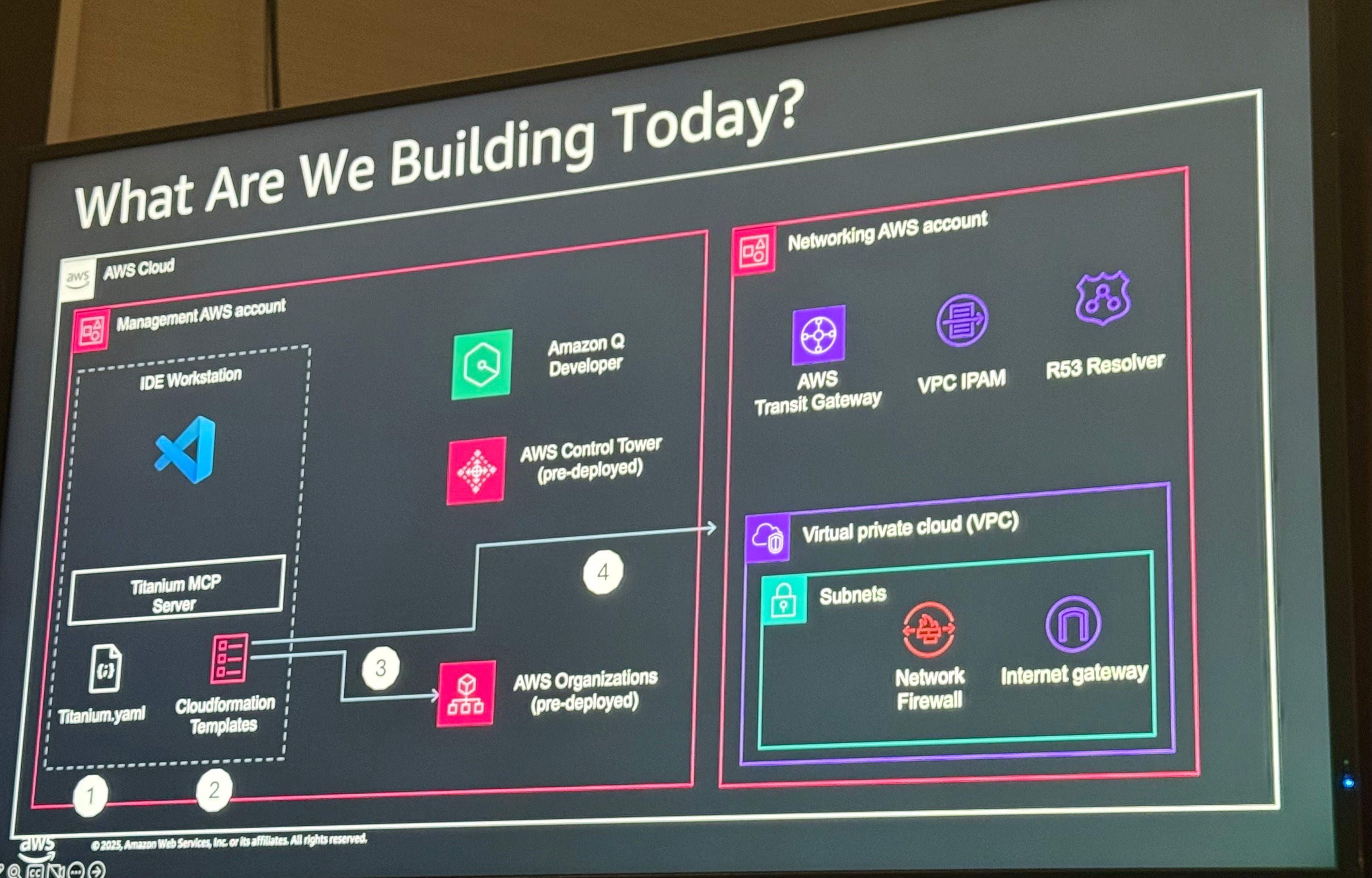
At a high level, Titanium Agent combines conversational AI with deterministic infrastructure-as-code. Instead of manually encoding every requirement into YAML and CloudFormation from scratch, you describe your organization in natural language: industry, size, AWS experience, risk tolerance, security needs, cost constraints, network preferences, and so on. Titanium then consolidates those answers into a structured configuration file that represents your landing zone design. This file becomes the single source of truth for decisions like which accounts to create, which OUs to use, which guardrails to enforce, how to route traffic, where to send logs, and how to manage budgets.
## Titanium’s capabilities are split into two main components that work together.
**Titanium Advisor** is the conversational guide: it interviews you about your organization, industry, security posture, and constraints, then turns those answers into a tailored titanium.yaml landing zone configuration and explains which choices it made and why. **Titanium Generator** is the execution engine: it takes that titanium.yaml file and transforms it into validated CloudFormation templates, then drives the step‑by‑step deployment of the landing zone so your design actually becomes running AWS infrastructure.
In practice, that means Advisor helps you make good decisions, and Generator makes sure those decisions are realized consistently in your AWS accounts.
Working through the re:Invent workshop, I was able to see how this plays out end-to-end. You start in an IDE with Amazon Q Developer, ask Titanium to help design a landing zone, and walk through a guided interview that chooses an appropriate “overlay” (for example, a starter configuration for a small or medium organization). As you answer questions, Titanium builds up titanium.yaml and can show you exactly how each answer influences the configuration. Once you are satisfied, Generator takes over: it validates the file, produces a set of CloudFormation templates for things like StackSets integration, IPAM delegation, Transit Gateway, inspection VPC, centralized logging, and backup policies, and then walks you through deploying them in the right order.
## Final Thoughts
What makes Titanium Agent so helpful is how it reduces friction and risk without hiding what is going on. The AI layer is used as a human‑friendly interface to gather requirements, propose patterns, and explain trade‑offs, but the actual landing zone is implemented with deterministic code and repeatable templates. That means you get the speed and accessibility of a conversational assistant while still keeping the predictability and auditability you need for production foundations. For new‑to‑AWS customers, Titanium offers an opinionated path to a well‑architected landing zone; for more experienced teams, it looks like a way to codify and scale design decisions while spending less time on boilerplate. Based on the lab experience at re:Invent 2025, Titanium Agent is a technology worth watching very closely as it moves toward general availability in 2026.
## Related Articles
##### [ AWS • March 23, 2026 How-to Guide on Rehosting with MGN 14 min read](https://blog.ippon.tech/how-to-guide-on-rehosting-with-mgn)
##### [ Azure • March 20, 2026 Rehosting Made Easy with AWS MGN 12 min read](https://blog.ippon.tech/exploring-rehosting-with-aws-mgn)
##### [ Discovery • December 17, 2025 Building a Well-Architected Snowflake Environment: Introducing Our Ippon Snowflake WAFR Custom Lens 5 min read](https://blog.ippon.tech/building-a-well-architected-snowflake-environment-introducing-our-ippon-snowflake-wafr-custom-lens)
### Comments
### Subscribe to Our Blog!
Stay informed with the latest insights and updates by signing up for our weekly blog newsletter – delivered straight to your inbox!
[Back to blog homepage »](https://blog.ippon.tech/)

Ippon is a consulting and expertise firm, who is convinced that technology is a source of progress for society. We help our clients leverage their digital assets to design an appropriate strategy and deploy their transformation roadmap at scale.
#### Navigation
- [Home](https://ipponusa.com/)
- [About](https://ipponusa.com/about-us/)
- [Services](https://ipponusa.com/services/)
- [Blogs](https://blog.ippon.tech/?__hstc=223043268.1036d82247623b329dfefe4e92697801.1714729179243.1714729179243.1714729179243.1&__hssc=223043268.2.1714729179244&__hsfp=803678701)
- [eBooks](https://ipponusa.com/ebooks/)
- [The Data Pour](https://info.ippon.tech/the-data-pour?__hstc=223043268.1036d82247623b329dfefe4e92697801.1714729179243.1714729179243.1714729179243.1&__hssc=223043268.2.1714729179244&__hsfp=803678701)
[Contact Us](https://ipponusa.com/contact/)
[Join Us](https://ipponusa.com/careers/)
#### Services
- [Data & Analytics](https://ipponusa.com/service/data-analytics/)
- [Cloud Strategy](https://ipponusa.com/service/cloud-strategy/)
- [Artificial Intelligence](https://ipponusa.com/service/artificial-intelligence/)
- [Operating Model](https://ipponusa.com/service/operating-model/)
- [Platform Modernization](https://ipponusa.com/service/platform-moderization/)
- [Product Innovation](https://ipponusa.com/service/product-innovation/)
#### Ippon International
- [France](https://fr.ippon.tech/?__hstc=223043268.1036d82247623b329dfefe4e92697801.1714729179243.1714729179243.1714729179243.1&__hssc=223043268.2.1714729179244&__hsfp=803678701)
- [Australia](https://au.ippon.tech/?__hstc=223043268.1036d82247623b329dfefe4e92697801.1714729179243.1714729179243.1714729179243.1&__hssc=223043268.2.1714729179244&__hsfp=803678701)
- #### Contact
- Ippon Technologies
[3431 West Leigh Street Richmond, VA 23230, USA](https://maps.app.goo.gl/RySm6SAwZnsxeiLz9)
- [(844) 477- 6687](tel:8444776687)
- [Sales@ipponusa.com](mailto:Sales@ipponusa.com)
©Copyright 2024 Ippon USA. All Rights Reserved. | [Terms and Conditions](https://ipponusa.com/privacy-policy/) | [Privacy Policy](https://ipponusa.com/privacy-policy/) | [Website by Skol Marketing](https://skolmarketing.com/)
```json
{
"@context" : "https://schema.org",
"@type" : "BlogPosting",
"author" : {
"@type" : "Person",
"name" : "Iryna Chmelyk",
"url" : "https://blog.ippon.tech/author/iryna-chmelyk"
},
"dateModified" : "2025-12-08T18:29:20.044Z",
"datePublished" : "2025-12-04T07:30:00.000Z",
"headline" : "AI for Landing Zone: Titanium Agent",
"image" : [ "https://blog.ippon.tech/hubfs/titanum.jpeg" ],
"mainEntityOfPage" : {
"@id" : "https://blog.ippon.tech/ai-for-landing-zone-titanium-agent",
"@type" : "WebPage"
},
"publisher" : {
"@type" : "Organization",
"logo" : {
"@type" : "ImageObject",
"url" : "https://blog.ippon.tech/hubfs/logo_SVG.svg"
},
"name" : "Ippon Technologies"
}
}
```