

AWS re:Invent 2025: Understanding the Event and the Major Innovations That Will Transform the Cloud

What is AWS re:Invent and Why Should Organizaiton Participate?
AWS re:Invent is Amazon Web Services' annual conference. Held in Las Vegas, it gathers over 60,000 enthusiasts—developers, architects, IT decision-makers, and business leaders—each year. The event plays a unique role in the technology ecosystem: it serves as a showcase for AWS innovations and largely defines the trajectory of the cloud for the coming years.
Participating physically or via live streams in AWS re:Invent allows you to:
- Understand major global technology trends (cloud, AI, data, security).
- Discover new AWS services and products in preview.
- Get training through several hundred technical sessions and hands-on workshops spread over the 5 days of the event. These sessions are partly led by AWS product leaders & experts, offering an unparalleled level and quality of training.
- Meet and exchange with AWS teams as well as ecosystem players.
- Draw inspiration from concrete feedback from companies in all sectors.
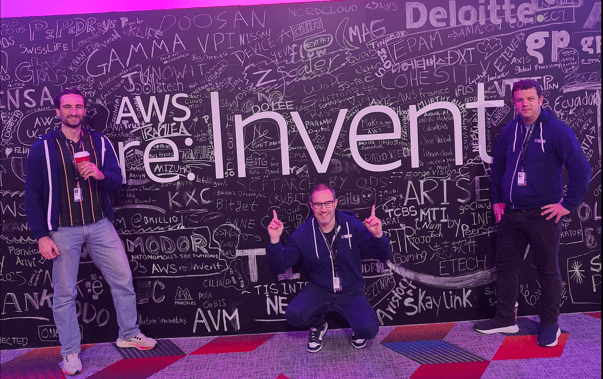
- For me: re:Invent presented an opportunity for me to step away from my weekly video calls with our US teams to spend this memorable moment together!
.jpeg?width=2048&height=1536&name=1764870422266%20(1).jpeg)
It is also a space for exchange between technical experts and business decision-makers, which makes it a particularly interesting event for those who wish to anticipate digital transformations.
Synthetic Overview: The Red Thread of re:Invent 2025
The dominant theme of re:Invent 2025 is undeniable: AI for the Enterprise—but not just models. AWS is pushing a comprehensive narrative that spans from foundation models to autonomous agents, including AI-optimized hardware, cost, and performance-optimized cloud offerings. The announcements fall into major categories:
- AI Models and Platforms: New models (Nova 2), customization offerings (Nova Forge), and Bedrock/Agent capabilities for producing production-ready agents.
- Agents & Agentic AI: Focus on "production-ready" agents (AgentCore, Bedrock agents) to automate business workflows.
- Infrastructure and Chips: New Graviton5 CPU, Trainium3 Ultra servers for training, and network/storage optimizations for data-intensive workloads.
- Data Platforms & Databases: RDS evolutions, new instance supports, updates for scalability and cost.
- Security, Observability, and Dev Productivity: Targeted improvements to facilitate enterprise adoption (audit, agent controls, observability for AI environments).
The highlight for me? The Frontier Agents, three new agents presented in preview:
- Kiro Autonomous Agent: Reads your codebase, learns team preferences, and can work alone for hours, even days.
- A security-dedicated agent that automatically performs code reviews and vulnerability scans.
- A DevOps agent capable of preventing incidents during production deployments.
These agents no longer just answer questions. They plan, code, test, and deploy. And above all, they remember you. Thanks to AgentCore's new memory function, an agent can retain your habits, code patterns, and internal processes.
My Highlight of re:Invent 2025
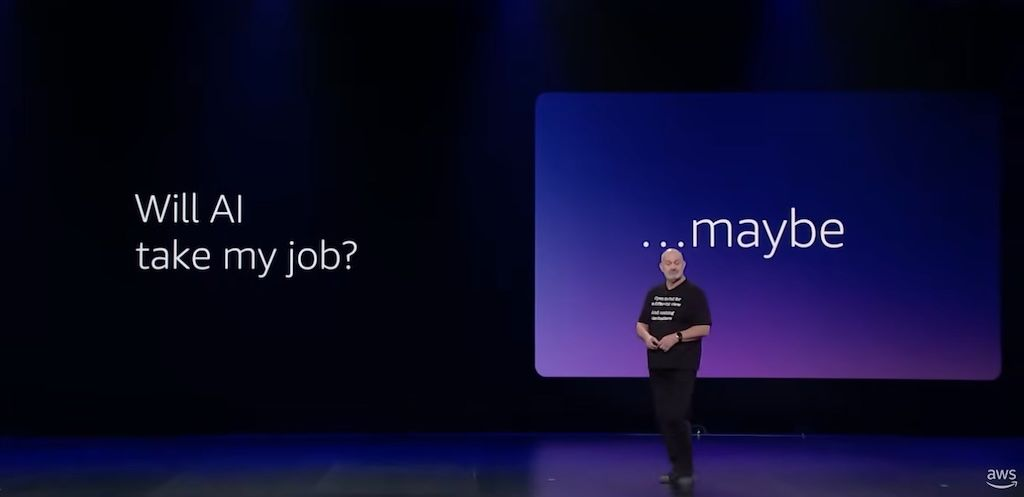
It was probably one of the most anticipated keynotes of this 2025 edition of re:Invent, "a special" Keynote by Amazon's CTO, Dr. Werner VOGELS.
He delivered a striking reflection on the future of programming and the "Renaissance Developer." This Keynote marked his final address as the main speaker. Through a moving and touching handover, his message addresses the entire technology community: it is now about embracing a broadened vision of development, where artificial intelligence becomes a partner serving human creativity.
But rather than elaborating in my own words, I invite you to watch it (1 hour well spent 🙂 ): YouTube Video Link
My Top 11 AWS re:Invent 2025 Announcements
For more details & available announcements: Top Announcements of AWS re:Invent 2025
1. AgentCore|Platform for "Production-Ready" AI Agents
AgentCore is the AWS platform for building, deploying, and managing robust AI agents. At re:Invent 2025, AWS added: a policy system (behavior rules / limits) to control what agents can do, episodic memory mechanisms (memory of past interactions), and a continuous evaluation framework (13 pre-built evaluators to measure agent quality, security, and compliance).
Impacts
- Allows launching AI agents into production securely and scalably, with guardrails and supervision.
- Facilitates maintenance, performance monitoring, and behavior control—reducing risks (errors, drift, uncontrolled behaviors).
- Reduces the cost and complexity associated with operationalizing AI agents, compared to "in-house" solutions.
Use cases
- Internal support or helpdesk agents (IT, HR, user support) capable of retaining conversation context over the long term.
- Agents that automate complex business workflows (orchestration, analysis, action triggering)—while respecting governance rules.
- Advanced, personalized, and compliant enterprise chatbots, with decision traceability and auditability.
2. Frontier Agents | Autonomous Agents for Code, Security, DevOps
AWS unveiled a new category of autonomous agents, the "Frontier Agents." The pack includes agents like Kiro ("code writer/dev assistant" agent), a security agent (code audit, review, vulnerability detection), and a DevOps agent (deployment assistance, incident prevention, operations automation).
These agents operate autonomously for hours, even days, without permanent human intervention.
Impacts
- Software development and operations become partially automatable — which can accelerate cycles, reduce errors, and decrease operational load.
- Possibility of making certain technical tasks accessible with fewer human resources.
- Reduction of "time to market" for application development and deployment.
Use cases
- An agent that generates code, corrects or improves modules, or automatically adapts legacy code (via Kiro).
- A security agent that scans code or configurations, identifies vulnerabilities, and issues alerts or corrects automatically—improving security posture.
- A DevOps agent that manages deployments, monitors incidents, automates rollbacks, or launches CI/CD pipelines—while respecting best practices.
3. Nova Forge | Customer AI Model Personalization
Nova Forge is a service that allows companies to start from a "starter" model (pre-trained checkpoint provided by AWS) and specialize it with their own data, to obtain a model adjusted to their domain/business. This avoids the cost and complexity of training from scratch.
Nova Forge integrates with the Amazon Nova model family (including the new versions presented in 2025), which facilitates deployment via AWS AI services.
Impacts
- Democratizes domain-specific AI: companies that are not pure ML labs can have tailor-made models.
- Reduces time-to-value: less effort in raw data science, faster to deploy.
- Improves the relevance of AI results—models are adapted to the company's vocabulary, data, and context.
Use cases
- Internal models for analyzing specific documents (contracts, reports, logs, etc.).
- Specialized business chatbots or assistants (customer support, technical support, internal FAQ).
- Personalized content generation according to the domain or custom data classification/extraction.
4. AWS AI Factories|On-Premise/Hybrid AI Infrastructure
AWS announced the AWS AI Factories offering: the ability for companies or organizations (particularly regulated or concerned about data sovereignty) to deploy AWS AI infrastructure directly in their own data centers. This can combine GPUs (or AWS chips), network, model services, etc., while retaining control over the data.
Impacts
- Allows organizations concerned with compliance, data sovereignty, or regulatory constraints (healthcare, government, finance sectors, etc.) to use AWS AI services.
- Reduces barriers to AI adoption for companies with "on-premise" or hybrid cloud constraints.
- Offers an alternative to total outsourcing: "private," high-performance, secure AI.
Use cases
- Deployment of internal AI models for sensitive data (customer data, personal data, regulated data).
- Exploitation of AI for business uses while respecting data localization constraints.
- Modernization of existing IT infrastructures with the addition of AI capabilities, without migrating entirely to the public cloud.
5. AWS Transform | Legacy Code Modernization + Accelerated Migration
The AWS Transform offering was presented as a service capable of modernizing applications, code, or even "legacy" languages or frameworks, using AI agents to rewrite code, migrate applications, or adapt inherited environments to modern stacks. AWS claims up to 5x faster acceleration than manual rewriting.
Impacts
- Reduces the cost and time of migrating or modernizing old applications.
- Facilitates the transition from old architectures to cloud-native stacks.
- Allows optimization of human resources by automating laborious parts (refactoring, rewriting, and compatibility).
Use cases
- Migration of legacy applications (.NET monoliths, old frameworks, obsolete programs) to modern architectures (microservices, serverless, etc.).
- Refactoring of old code to improve maintainability, security, or performance.
- Conversion of old codebases for integration into modern CI/CD pipelines or cloud architectures.
6. Multicloud AWS | Google Cloud (Interconnect/Networking)
AWS and Google Cloud announced a multicloud connectivity service, allowing the establishment of high-speed private links between AWS and Google Cloud via a managed interconnected network, simplifying the setup of cross-cloud architectures.
Impacts
- Facilitates the coexistence of infrastructures and services in multiple clouds while maintaining guaranteed network performance.
- Reduces technical complexity for organizations that want to leverage AWS + Google Cloud services simultaneously.
- Allows for more robust and flexible hybrid / multi-cloud architectures.
Use cases
- Having applications or data pipelines distributed between AWS and Google Cloud (e.g., storage on AWS, analytics on GCP).
- Cross-cloud high availability, resilience, or geographical / multi-region distribution scenarios.
- Progressive migration or "cloud agnostic": some workloads on AWS, others on Google Cloud, with private connectivity.
7. New Generation of Nova Models
AWS expanded the Amazon Nova family with new foundation models covering various uses: text generation, multimodal (text/image/audio/video), conversation, code, agents, etc.
Impacts
- Offers a versatile base for many use cases, without requiring training from scratch.
- Makes AI more accessible to businesses—a single model may suffice for text, images, multimedia, or agents.
- Facilitates the integration of AI into diverse applications, from content generation to multimedia analysis.
Use cases
- Multimodal chatbots/assistants (text, voice, image).
- Content generation, automatic summarization, media conversion, multimedia enrichment.
- Support for creativity (images, media), rapid prototyping, and adapted UX.
8. High-Performance AI Training | Trainium3 UltraServers + Graviton5 for AI/Generic Comput
AWS introduced AI-optimized servers: Trainium3 UltraServers, enabling faster and more efficient training of large AI models than classic GPUs, with improved performance and energy efficiency. Concurrently, AWS launched more powerful in-house CPUs for general compute: AWS Graviton5, for non-AI cloud workloads (applications, databases, data, etc.).
Impacts
- Reduction of costs and time for training or inferring AI models, making large-scale AI more accessible.
- Better energy efficiency and performance for general-purpose cloud workloads—potential TCO reduction.
- Allows for standardization of infrastructure around an AWS stack optimized for AI + classic compute.
Use cases
- Internal training of large AI models (LLMs, multimodal).
- Large-scale inference for production applications.
- Hosting of backend, data, or analytics applications optimized for cost/performance.
9. Security & Compliance Updates Related to AI Agents/CLoud Workloads (e.g., Monitoring, Audit, Threat Detection)
With the rise of AI agents and dynamic workloads, AWS extends its security services: monitoring of EC2/ECS environments, detection of suspicious behavior, auditing and logging of actions, agent interaction logs, and large-scale compliance.
Impacts
- Better risk management related to AI and agents: data leakage, unauthorized actions, and drift.
- Increased confidence for companies in deploying AI in production.
- Reduction of the load on security/compliance teams, with automated monitoring.
Use cases
- Regulated environments (healthcare, finance) where every action must be traced.
- Deployment of AI agents in production with full auditability.
- Automatic threat detection in complex cloud architectures.
10. Serverless Integration & AI Orchestration | Combining Functions, Agents, and Workloads
Thanks to the combination of AgentCore, Frontier agents, Nova models, and optimized infrastructure (Trainium, Graviton), AWS makes it possible to implement hybrid serverless + AI architectures: short functions, long-running agents, data pipelines, and action automation.
Impacts
- Simplifies the development of modern applications combining AI & cloud.
- Offers more flexibility and modularity in the architecture: serverless, agents, data, and orchestration.
- Allows for the construction of adaptive, scalable, and more dynamic systems.
Use cases
- Data processing pipelines + AI + automation (e.g., ingestion, cleaning, inference, action).
- Complex business applications, combining user interface, AI, and backend orchestration.
- Dynamic workflows: sequences of AI actions + serverless + agents based on events.
11. Governance & "Fair Use" of AI Agents | Supervision, Control, Ethics
With AgentCore tools (policy, memory, evaluation) + security and monitoring services, AWS is implementing a framework so that its AI services and agents are compliant, controllable, auditable, and respectful of ethics/compliance rules.
Impacts
- Reduces the risks of drift, non-compliance, or misuse of AI.
- Facilitates the adoption of AI in sensitive sectors—finance, healthcare, and confidential data.
- Allows for reconciliation of innovation (AI, agents) and compliance with regulatory constraints.
Use cases
- AI agents in production with audit logs, action control, and full traceability.
- Sensitive applications (personal, confidential) require transparency, compliance, and governance.
- Hybrid AI + human systems, where humans retain a role of supervision/validation.
Why this "Top 11" Illustrates a Major Turning Point for the Cloud and AI
With these announcements, AWS—historically a cloud infrastructure provider—is positioning itself more than ever as a complete "end-to-end" AI platform: infrastructure, models, agents, governance, connectivity, on-premise/cloud hybridization, orchestration, etc. This means that AI is ceasing to be a mere technological addition to become a central foundation of the information system—accessible, scalable, and industrializable.
For businesses, this is an opportunity to drastically shorten the path between the AI idea and its deployment into production, while maintaining control, security, and governance.

Comments