

Beyond the Model: Designing Reliable Sentiment Analysis in the Age of BERT


Introduction
Sentiment analysis has shifted from being a “nice to have” aspect of any kind of analysis. Instead, these days, many businesses regard this aspect as an actual direct feed need for product, experience, or operational inputs. This trend has turned out to be even more significant in the wake of businesses being subjected to an ever-increasing amount of unstructured text inputs, such as social postings, purchase reviews, support queries, and in-house opinions.
However, times have changed. Today, people are not satisfied anymore with dashboards that cannot recognize sarcasm, miss undertones of discontent, or misunderstand the context. As a result, there is a move towards using the transformer architectures, like BERT (Bidirectional Encoder Representations from Transformers), by some teams.
But adopting BERT is not just a modeling decision. It is an architectural, operational, and organizational choice. In this blog, we will examine both the technology and the way sentiment analysis systems should appear in this new world of BERT, when this technology works, when it fails, and how it should be applied.
The Problem: Why Sentiment Analysis Breaks at Scale
Traditional techniques used for sentiment analysis, such as keyword matching, rule-based systems, and bag-of-words classifiers, were developed with the earlier, simpler world of text analysis in mind and perfectly showcase the idea that sentiment can be determined based upon the presence/absence of certain keywords within the text. This is only true when done in more controlled environments.
Text is very informal, reduced, and highly contextual. Look at expressions such as:
- “Not bad at all.”
- “This update really helped… break everything.”
- “I thought this would be great. I was wrong.”
In each instance, the interpretation of meaning is dependent on the pattern of word order, tone, and implication, and not solely on distinct keywords. A system that does not consider these subtle details produces noisy indicators that undermine confidence in downstream analysis.
The reason this matters is that the results of sentiment analysis are rarely, if ever, looked at in a vacuum. Results impact priority routing, escalation, marketing, and executive reporting. When sentiment analysis models are suboptimal, the issue isn’t simply with misclassifications—it’s with poor decisions.
Why BERT Represents a Step Change
BERT signifies a revolution in language representation in machine learning models. Unlike other models that focused on individual words or sequential processing of text data, BERT processed an entire sentence in a bidirectional way so that each word could be viewed in the light of all other words around it. This helped such models to understand the syntax and semantics of words in natural language, which was crucial to understanding the emotions and intentions embedded in language.
In sentiment analysis, contextual models make it easier to handle negation, sarcasm, and subtle language cues—challenges that are especially common in short, informal text such as tweets. Because these models learn meaning from context rather than relying on isolated words, the need for extensive manual feature engineering is significantly reduced. As a result, sentiment predictions improve in tasks where meaning is highly dependent on phrasing and context. For these use cases, transformer-based models such as BERT or DistilBERT are often the most effective solution.
From Bag-of-Words to Context-Aware Sentiment
Through my hands-on experience building and evaluating sentiment analysis systems, one pattern became clear: the biggest improvements in sentiment quality came not from adding features or tuning thresholds, but from rethinking how language is represented.
In practice, traditional baselines using TF-IDF (Term Frequency-Inverse Document Frequency) vectors and linear classifiers provided a strong starting point. They are efficient and interpretable, but they treat text as an unordered collection of words. For short, informal content such as social media, this assumption often fails—negation, sarcasm, and subtle phrasing frequently lead to confident but incorrect predictions.
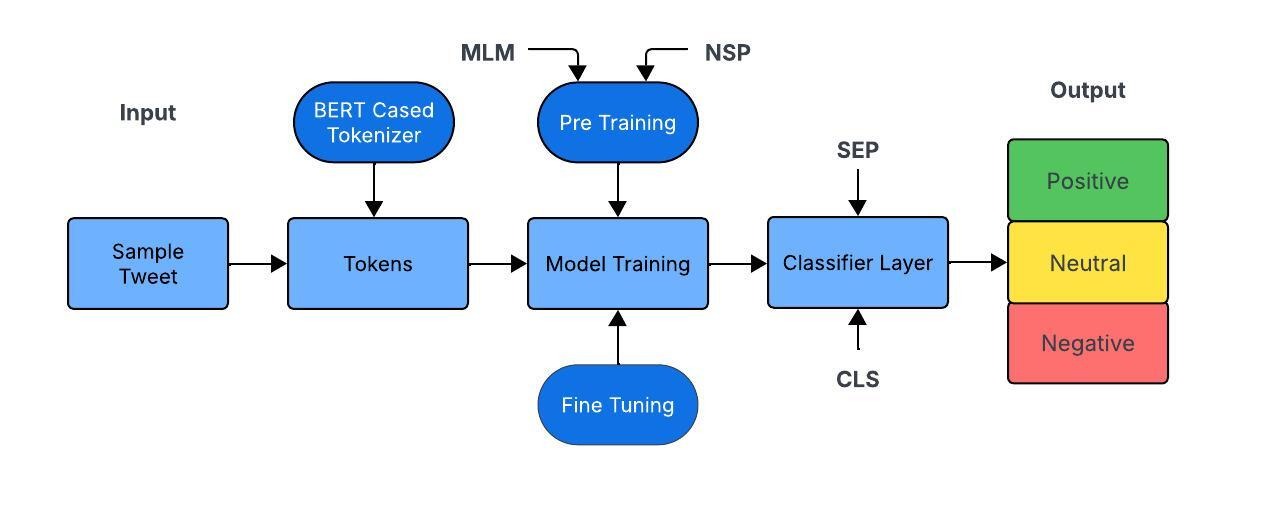 Based on these observations, a contextual approach using a fine-tuned BERT model was applied. Rather than relying on handcrafted features, BERT learns sentence-level representations through bidirectional attention. The final sentiment prediction is derived from the [CLS] token, which captures the overall semantic context of the input.
This shift from word-frequency features to contextual embeddings was the primary driver of the observed performance gains. More importantly, it eliminated entire classes of errors common in baseline models, producing sentiment predictions that aligned more closely with human interpretation.
Context & Constraints: Where BERT Fits and Where It Doesn’t
Despite its advantages, BERT is not a universal solution.
BERT-based sentiment analysis is applicable under the following conditions:
- Text is noisy, ungrammatical, and highly variable
- Accuracy of sentiment has direct implications for business outcomes
- A slight increase in inference latency can be tolerated
- Teams have the ability to manage models’ lifecycle and monitoring
Applications include customer feedback analysis, social media tracking, and support ticket categorization.
However, it should be noted that BERT comes with some non-trivial constraints. Firstly, the computation needed by the transformer architecture consumes more resources compared to other models. Secondly, it offers lesser interpretability when compared with other models, and this can be a problem when working in regulated domains or when interpretability becomes strictly necessary.
Moreover, the use of BERT in a production setup calls for operational maturity, which includes planning for versioning, retraining, performance, and costing. Otherwise, the models developed would potentially become successful in the experimental setting but become ineffective in the production stage.
Our Point of View: Accuracy Is Not the Only Goal
The clear recommendation is that you should apply BERT where there is a material difference due to contextual understanding, and not just because it is the current state of the art.
Many instances still require only classical models. For overall megatrends or non-sensitive usages, less complicated models assure faster implementation, costs, and traceability.
Even so, the impact of sentiment-related prioritization, automation, or engagement decisions, where misclassification becomes costly, is where the BERT benefits of better context understanding tend to outweigh the increased complexity.
In one sentence:
BERT is most valuable when understanding nuance matters more than simplicity.
Practical Guidance for Teams Implementing BERT
Successful sentiment analysis systems are created and not just trained.
To begin with, teams should set a strong baseline to measure the benefits of contextual models. Evaluation metrics should reflect the business objectives; in fact, macro or weighted F1 scores usually provide more insights than mere accuracy.
From an operational standpoint, sentiment models need to be constantly checked for drift as the language usage evolves. The plan for retraining should be there, rather than doing it reactively. The inference latency and costs should be assessed by running the entire realistic workload and not just through examples in notebooks.
Among the common mistakes are treating model deployment as a one-off effort, underestimating the operational costs, and simply assuming that better model accuracy leads to higher business performance. Indicators that it might be a good idea to take a fresh look at the approach are increased costs, lowered performance, or changes in data sources and use cases.
Conclusion: Designing for Reliability, Not Just Performance
Sentiment analysis has grown from a simple text classification task into a critical analytical capability. As organizations demand more reliable insights from unstructured data, contextual models like BERT provide a meaningful upgrade over traditional techniques.
However, the real challenge lies beyond the model. Reliable sentiment analysis requires thoughtful system design, clear tradeoff decisions, and operational discipline. When applied with intention, BERT enables sentiment systems that better reflect how people actually communicate and ultimately support better decisions.
For organizations willing to invest in the necessary infrastructure and governance, BERT-based sentiment analysis is more than a technical upgrade; it is a strategic one. If your organization is exploring or implementing transformer-based sentiment analysis, we would be happy to share lessons learned and help evaluate the right approach—feel free to reach out at sales@ipponusa.com.


Comments